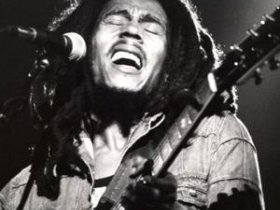

Jamaica in the 1970s was a country at war with itself: the governing People’s National Party of Prime Minister Michael Manley and Edward Seaga’s Jamaica Labour Party, each with armed enforcers fighting street by street for control of the vote, History.com summarises. Bob Marley, shot at his home in December 1976, had spent 15 months in London.
A truce made in a cell
The idea for the concert came from the two men whose gunmen did the fighting. Claudius “Claudie” Massop, the JLP-aligned Tivoli Gardens don, and his PNP counterpart Aston “Bucky” Marshall were held in the same jail cell in early 1978 and emerged calling themselves a peace committee, the Guardian’s Robin Denselow recalls. The Jamaica Observer records that it fell to Massop to fly to London and persuade Marley to return and headline. He came home in late February 1978.
April 22, 1978
The One Love Peace Concert opened at 5 p.m. at the National Stadium in Kingston before a crowd put at 30,000 to 35,000, with 16 acts including Jacob Miller, the Mighty Diamonds and Peter Tosh. Denselow, who was there, called it “the longest and most political reggae concert ever staged.”
Marley appeared shortly after midnight — his first performance in his own country in nearly two years, History.com notes. During “Jamming” he summoned Manley and Seaga to the stage. A photographer working the stage that night wrote in the Observer: “Seaga was the first to be pulled to the platform, followed quickly by Manley. Positioned between the leaders with hands on both their shoulders, Marley literally pulled them together as they shook hands. Bob then placed his hands on the hands of both leaders and raised them in a show of Peace and One Love to the applause of the audience.” The two men, on whose behalf hundreds had died, “appeared uncomfortable,” History.com observes. Under a full moon, in the early hours, the concert ended with Manley and Seaga embracing Massop and Marshall.
The medal, and the aftermath
On June 15, 1978, at the Waldorf Astoria in New York, Marley received the United Nations Peace Medal of the Third World for the effort. The peace did not hold. Massop was shot dead by police in Kingston in 1979; Marshall was killed in a New York nightclub in 1980; the 1980 election that swept Seaga to power cost an estimated 700 lives, History.com records. When Manley and Seaga next shook hands in public, the Observer notes, it was at Marley’s funeral in the National Arena in May 1981.
Why it matters
Marley was 33. He had made the most acclaimed album in the world the previous summer, and he used the fame to drag two heads of state onto a stage in front of the people they had armed. No moment in Jamaican music is photographed more often, and none carries more weight.
Listen and dig deeper
- Kaya, the 1978 album drawn from the same London sessions as Exodus, is in the Listen library: Kaya. Browse Bob Marley, Peter Tosh and Jacob Miller.
- Previously: ‘Exodus’ (1977). Next: Bob Marley, 1945–1981.
Sources: The Guardian — “Bob Marley presides over the Peace Concert” (Robin Denselow, from the archive, June 16, 2011); Jamaica Observer — “Recollections of the One Love Peace Concert” (April 21, 2013); History.com — “Bob Marley headlines One Love Peace Concert, April 22, 1978”; History.com — “How Bob Marley Used the ‘One Love’ Concert as a Gesture for Peace”; Bob Marley official — UN Peace Medal, Waldorf Astoria, June 15, 1978 (Lynn Goldsmith photograph).
Editor’s note: This entry is part of the JamaicansMusic online museum — a career timeline assembled from the archive. It is dated to the events it documents; every claim is drawn from the linked sources.