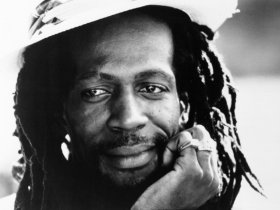

Gregory Anthony Isaacs was born in Fletcher’s Land, west Kingston, on 15 July 1951 — some obituaries give 1950 — and raised by his mother in nearby Denham Town, according to David Katz’s Guardian obituary. He named her as his first vocal model: he heard her singing while she ironed. Sam Cooke, Otis Redding, Alton Ellis and the Melodians did the rest.
A false start, then a trio
He came up through the talent-show circuit, including the Vere Johns Opportunity Hour, the New York Times notes. His recording debut came in 1968: “Another Heartache,” a duet with Winston Sinclair that, in the Guardian’s words, “sank without a trace.” A single for Prince Buster, “Ballroom Floor,” followed. In 1969 he formed the Concords, a trio modelled on the Melodians, and cut a handful of sides for Rupie Edwards — “Don’t Let Me Suffer” the standout — but saw little money from any of it.
African Museum
The answer was to own the means of production. By 1970, the Guardian records, Isaacs had set up the independent African Museum label with fellow singer Errol Dunkley. Dunkley’s “Movie Star” was the first hit. Isaacs’s “My Only Lover,” backed by the Wailers’ rhythm section, was the second — and, the Independent argues, the record that “created the template for the influential Lovers Rock style.” Dunkley soon left to run his own imprint; Isaacs kept the name and ran it alone. “If I produce myself, I’m gonna exploit no one, just myself,” the Independent quotes him as saying.
The first hits
Self-production did not stop him working for others. In 1973 the downtown promoter Phil Pratt produced “All I Have Is Love,” his first substantial hit. In 1974 came a bigger one: “Love Is Overdue,” the first of several for Alvin “GG” Ranglin, who also cut “My Number One” and “The Border” with him and issued Isaacs’s debut album In Person in 1975. The singer’s voice — plaintive, unhurried, always a little wounded — was now unmistakable on Jamaican radio.
Why it matters
Before the Cool Ruler nickname, before Island Records, Gregory Isaacs was already a label owner. African Museum would carry his Jamaican releases for the rest of his life, including the home pressing of Night Nurse. The independence he claimed here is the spine of the whole career.
Listen and dig deeper
- Play In Person and All I Have Is Love in the Listen library, and browse Gregory Isaacs and Errol Dunkley.
- Next on the timeline: Cool Ruler, Front Line and Rockers (1978).
Sources: The Guardian — “Gregory Isaacs obituary” (David Katz, Oct 25, 2010); The Independent — “Gregory Isaacs: Reggae singer and Lovers Rock pioneer” (Pierre Perrone, 2010); The New York Times — “Gregory Isaacs, Reggae Singer and Songwriter, Dies at 60” (Rob Kenner, Oct 25, 2010); AllMusic — Gregory Isaacs biography.
Editor’s note: This entry is part of the JamaicansMusic online museum — a career timeline assembled from the archive. It is dated to the era it documents; every claim is drawn from the linked sources.